


Economic momentum is fading
Economic Update
Employers added 119,000 jobs in September, above consensus estimates, but the report revealed notable weaknesses. The unemployment rate rose to 4.4%, its highest level in nearly four years. Job gains for July and August were also revised downward by a combined 33,000. Meanwhile, the release of third-quarter GDP and October spending data has been delayed due to the recent government shutdown. October inflation figures were also canceled, with the November CPI report now scheduled for publication after the Federal Reserve’s final meeting of 2025. Markets remain evenly split on whether the Fed will cut interest rates in December, as policymakers weigh slowing job growth against persistent inflation.
State of Corporate Credit
Distressed debt exchanges (DDEs) have been a notable trend in the financial landscape, with S&P noting that since January 2023, distressed exchanges produced more than half of all defaults. Since early 2025, distressed debt exchanges are running at a pace nearly twice that of all other default types. In October alone, corporate defaults rose to 10, eight of which were DDEs. Distressed debt exchanges accounted for 54% of year-to-date defaults, underscoring heightened refinancing risk. These exchanges typically occur when financially troubled companies negotiate with creditors to restructure obligations and avoid bankruptcy.
Insolvencies
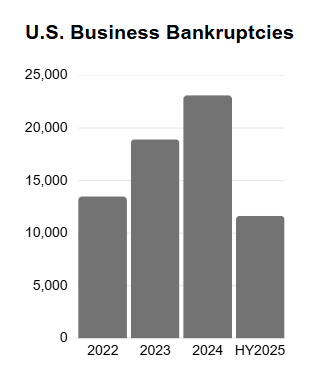
Commercial Chapter 11 bankruptcy filings rose 11% year to date in October 2025 compared to the same period last year, while small business filings, captured as subchapter V, surged 35% according to Epiq AACER data. S&P Global Market Intelligence also reports that bankruptcy filings through October 2025 are on pace to reach a 15-year high. Bankruptcies were most concentrated in the industrial and consumer discretionary sectors, as companies continue to grapple with declining sales and shrinking profit margins. Canadian business insolvencies dropped in Q3 2025, down 15.5% year over year. However, CAIRP warns this decline doesn’t necessarily signal stronger businesses. Many owners may be delaying filings by juggling debt or negotiating informally, while others simply close without entering the insolvency system.
Current & Evolving Credit Risks
Supreme Court Tariff Decision
On November 5, the Supreme Court heard oral arguments on tariffs imposed by the Trump administration under the International Emergency Economic Powers Act (IEEPA). The justices appeared skeptical of the administration’s argument that the power to tariff has been delegated to the president. While some expect a ruling from the court on an expedited basis, perhaps even before the end of the year, the process could stretch to June 2026. The outcome will have significant implications for global markets and supply chains. If upheld: The president retains broad tariff powers, and existing tariffs likely remain, aligning with the administration’s strategy of using tariffs to advance economic policy goals. If limited: Congress regains control, and tariff levels may be adjusted. This also raises the question of whether importers could be entitled to a refund, posing financial challenges.
Impact of Metal Tariffs on Construction and Automotive Sectors
With the introduction of 50% tariffs on aluminum, steel, and copper imports, U.S. builders and automakers are under mounting pressure. According to US Geological Survey (USGS) data, the construction sector remains the largest consumer of steel and copper in the country. Tariffs have driven material costs sharply higher: steel mill products are up 13.1% year over year, copper wire and cable up 13.8%, and iron and steel up 9.2%. These increases have triggered project delays, cancellations, and growing investment hesitancy among business owners. In the aluminum market, transportation dominated U.S. demand in 2024, accounting for 36% of consumption. Automakers now face billions in added costs and are actively exploring alternative materials. Meanwhile, U.S. steel producers are adapting to secure business. Cleveland-Cliffs, for example, introduced unprecedented three-year fixed-price contracts to car manufacturers. Looking ahead, the U.S. Commerce Department’s Bureau of Industry and Security is weighing an expansion of Section 232 duties to cover additional steel and aluminum products, a move that could further strain companies within these sectors.