
diverging trends amid growing turbulence
Economic Update
In June, the Federal Reserve held rates steady at 3.5%–3.75% for the fourth consecutive meeting. However, nine of 19 officials now expect at least one rate hike by year-end, a notable shift from March, when none projected an increase. Inflation remains above the Committee’s 2% target, partly due to supply shocks that have driven higher prices in sectors such as energy. New Chairman Kevin Warsh emphasized that the Fed would prioritize price stability, making no reference to its dual mandate of supporting the labor market, signaling that controlling inflation has become the central bank’s primary focus. There is high probability of another rate hold at the Fed’s July 28-29 meeting.
State of Corporate Credit
U.S. defaults are on the rise as S&P’s monthly default count rose sharply to 17 in May, the highest monthly total since May 2025. The ratings agency expects global defaults to rise to 3.8% through March 2027. Of significance, the U.S. is the only area where defaults have increased year over year. In contrast, all other regions have seen declines in default activity. It is noted however, that the U.S. region reflects the size of the rated universe and the larger cohort of lower ratings. Defaults were concentrated in a few sectors, led by consumer products and chemicals, packaging and environmental services, and followed by retail and restaurants and transportation.
Insolvencies
While commercial Chapter 11 filings declined 7% year over year in May, small business filings rose sharply, increasing 36% compared to May 2025. Elevated costs, tight credit conditions, and ongoing geopolitical uncertainty continue to pressure businesses, particularly small businesses.
In Canada, business insolvencies declined by 7.5% in the first quarter of 2026 compared to the same quarter last year. While business insolvencies declined year over year, they rose 9.8% quarter over quarter in Q1 2026, driven by softer demand, higher fuel and input costs, elevated borrowing costs, and renewed trade and supply chain uncertainty. Filings also remain 27.6% above the first-quarter pre-pandemic average.
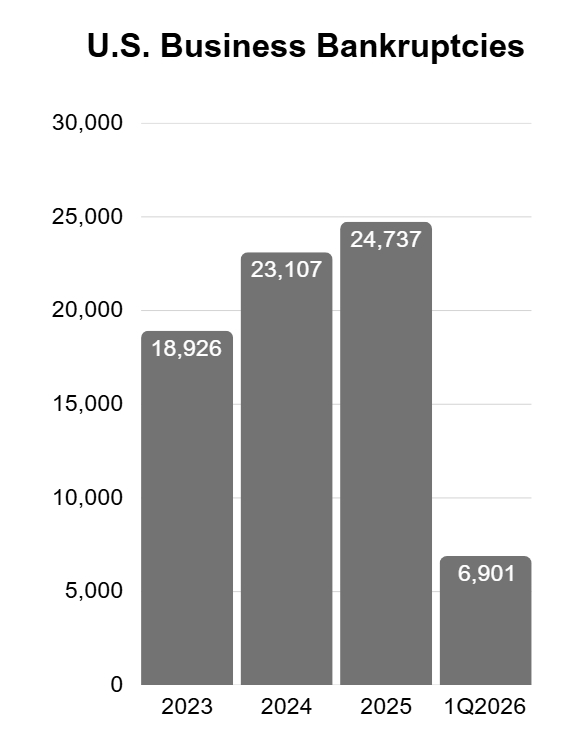
Source: U.S. Bankruptcy Courts—Business and Nonbusiness Cases Filed, by Chapter of the Bankruptcy Code
Current & Evolving Credit Risks
U.S.-Iran Agreement
The U.S. and Iran reached a 14-point memorandum of understanding, establishing a ceasefire, reopening the Strait of Hormuz, and setting a 60-day period for further negotiations on nuclear and sanctions issues. However, maritime traffic remains limited as unresolved security questions are keeping carriers and shipowners on the sidelines. Only a gradual recovery in shipping and energy flows is expected. The International Maritime Organization (IMO) is working with countries to establish a safe corridor for stranded seafarers.
U.S. Housing Market Challenges
The U.S. housing market is contracting as weak demand and elevated costs sideline buyers and renters. Affordability constraints, driven by high home prices and interest rates, continue to suppress demand, with borrowing costs near record highs. Mortgage delinquencies have risen above pre-pandemic levels and are expected to climb further as a slowing economy and persistent inflation pressure borrowers. These headwinds are weighing on margins and operating performance for homebuilders such as D.R. Horton, Lennar, and Toll Brothers, as well as their broader supply chain. S&P notes that only 25% of U.S. homebuilder and developer ratings in their portfolio are investment grade (‘BBB-’ or higher), while 36% fall in the ‘B’ category, an area that warrants close monitoring given current conditions. New residential construction and repair-and-remodeling spending will remain subdued this year.
Details Behind Global PMI Data
S&P Global’s Manufacturing PMI signaled a sharp acceleration in global factory output in May, the fastest pace since July 2021. However, the surge appears driven less by underlying demand and more by precautionary inventory building, as firms stockpile inputs to guard against potential supply disruptions and price increases tied to ongoing geopolitical uncertainty in the Middle East. While this behavior supports near-term production, it risks pulling forward demand. As inventories build and precautionary buying subsides, the cycle is likely to reverse, leading to weaker input orders, softer production, and slower sales growth. This dynamic could amplify volatility across the manufacturing sector, particularly if end-market demand fails to keep pace with elevated inventory levels.