


energy shocks and geopolitical tensions
Economic Update
The U.S. federal funds rate remains at 3.5%–3.75% after the Federal Reserve held rates steady at its March meeting. However, elevated market volatility is the central challenge facing policymakers. The longer energy prices remain high and the Strait of Hormuz stays constrained, the greater the risk that inflation becomes entrenched across a broad range of goods and services, supply‑chain disruptions intensify, and economic growth and employment begin to slow. The next rate decision is scheduled for June and will likely coincide with a change in leadership, as Jerome Powell’s term as chair ends on May 15, 2026. President Trump has nominated Kevin Warsh to succeed him.
State of Corporate Credit
The latest Federal Reserve Senior Loan Officer Opinion Survey reported that banks tightened lending standards for commercial and industrial (C&I) loans across all firm sizes. Demand for C&I loans strengthened among large and middle‑market firms but remained essentially unchanged for small firms. Interestingly, a second set of special questions queried banks about their likelihood of approving loans to firms with various levels of exposure to artificial intelligence (AI). Banks reported, on net, being more likely to approve loans to firms benefiting from high AI exposure and less likely to approve loans to firms adversely affected by high AI exposure.
Insolvencies
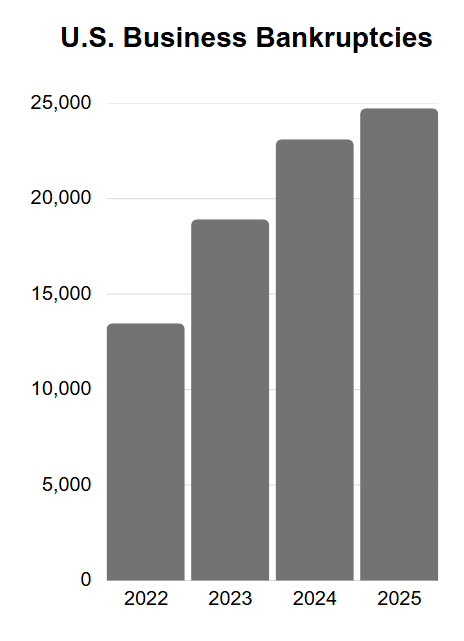
Subchapter V small business filings jumped 67% year over year, while total bankruptcies rose 14%. Commercial chapter 11 filings also increased 37%. Persistent inflation, restricted credit, and global instability continue to pressure corporations and small businesses alike.
In Canada, the total number of insolvencies (bankruptcies and proposals) increased by 8.0% in February 2026 compared to the previous month. Bankruptcies increased by 6.1% and proposals increased by 8.5%. The total number of insolvencies in February 2026 was 11.9% higher than the total number of insolvencies in February 2025. Consumer insolvencies increased by 12.9%, while business insolvencies decreased by 10.5%.
Current & Evolving Credit Risks
Private Credit Under Pressure
Growing concerns in the private credit market have driven a surge in investor redemption requests. These redemptions can create liquidity pressure for private credit funds and may ultimately reduce the amount of capital available to portfolio companies. According to a Business Insider analysis of SEC filings, investors sought to withdraw a record $19.5 billion from private credit direct lending funds in the first quarter alone. While some managers are honoring redemption requests, withdrawals across private asset strategies are increasingly being constrained through the use of “gates.” Managers can “gate” redemptions when too many clients want their money out at the same time. In this environment, credit professionals should monitor any portfolio companies linked to private credit.
Iran War Driving Up Plastics Pricing
The plastics industry was already under strain when the war with Iran started. The conflict has sent prices for crude oil, naphtha, and polymer feedstocks higher, while triggering significant disruptions across global supply chains. Middle East producers represent about 20% of total global polyethylene supply. This concentration makes the industry particularly vulnerable to price shocks. Rising costs are, in turn, increasing credit exposure, a risk that should not go unchecked. While large chemical producers such as Dow and LyondellBasell are benefiting from higher prices, packaging manufacturers like Amcor and Magnera are feeling the squeeze.
Middle East Tensions Disrupt Growth
The International Monetary Fund (IMF) projects that global economic growth will slow to 3.1% in 2026 and 3.2% in 2027, down from 3.4% in 2025. Global headline inflation is expected to rise modestly in 2026 before resuming its downward trend in 2027. These projections assume that the conflict in the Middle East remains limited in both duration and scope. A longer or broader conflict, increased geopolitical fragmentation, a reassessment of expectations for artificial‑intelligence‑driven productivity gains, or renewed trade tensions could substantially weaken growth and destabilize financial markets. Overall, downside risks dominate the outlook.