
Resilience Tested by Emerging Headwinds
Economic Update
While U.S. inflation cooled more than expected in June 2026, the Federal Reserve is still not ruling out future interest rate increases. Lower energy prices and a flat core CPI reading reduced immediate pressure for a rate hike at the Fed’s July meeting, but several policymakers indicated that rates may still need to rise if inflation remains stubbornly above the Fed’s 2% target. Fed Chair Kevin Warsh is under pressure to demonstrate his commitment to controlling inflation. Ongoing risks include renewed tensions with Iran, new U.S. tariffs, and potential price increases related to AI-driven demand for technology products that could push inflation higher. As a result, a July rate hike appears unlikely, but the possibility of hikes later in 2026 remains very much on the table.
State of Corporate Credit
Fitch Ratings reported that the U.S. Private Credit Default Rate remained elevated at 6.0% for the 12 months ended May 2026, matching April 2026’s record high. Healthcare providers, industrial and manufacturing, and business services accounted for the most default activity. Notably, the industrial and manufacturing sector’s default rate climbed to 10.3%, surpassing consumer products and marking a significant increase from 3.2% a year earlier. Interest payment deferrals and PIK interest accounted for 52% of default events, while distressed maturity extensions represented 36%. Uncured payment defaults, bankruptcies, liquidations, debt-for-equity swaps, and out-of-court restructurings comprised the remaining 12%.
Insolvencies
According to Epiq and American Bankruptcy Institute data, Subchapter V filings increased 50% year over year in the first half of 2026, while commercial Chapter 11 filings rose 28%. Total commercial bankruptcies were also up 13%, signaling continued financial strain across the market. As a result, suppliers may continue to face heightened counterparty risk for the remainder of 2026.
Canada insolvencies in May 2026 increased modestly year over year, with total filings up 1.1%, including a 3.6% rise in business insolvencies. Meanwhile, 20 Companies’ Creditors Arrangement Act (CCAA) filings were recorded in Q1 2026, unchanged from the prior year, with the manufacturing sector accounting for the highest volume.
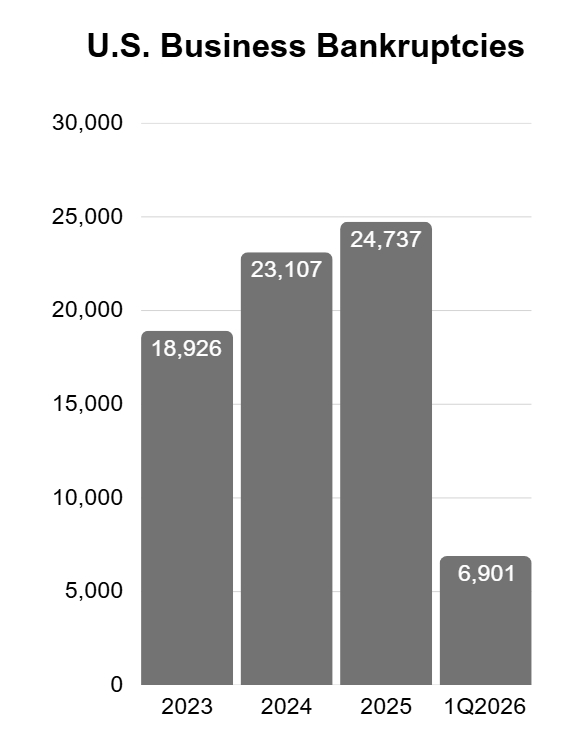
Source: U.S. Bankruptcy Courts—Business and Nonbusiness Cases Filed, by Chapter of the Bankruptcy Code
Current & Evolving Credit Risks
Packaging Sector Challenges
Inflationary pressures continue to weigh on the packaging sector’s recovery, with recent Middle East disruptions adding further uncertainty. Rising costs for key inputs, including aluminum, polyethylene, and polypropylene, are expected to persist across major end markets such as food and beverage, personal care, household products, and consumer durables. Elevated raw material prices may pressure margins and limit earnings recovery for packaging manufacturers. Consumers are also facing slower wage growth and tightening discretionary budgets, adding additional risk for highly leveraged packaging companies.
Changing Tariff Landscape
President Trump announced a 50% tariff on a broad range of Canadian imports, including dairy products, cement, plywood, paper, furniture, wine, and hockey equipment. The tariffs, scheduled to take effect in 30 days, were cited as a response to what the administration described as discriminatory Canadian policies affecting U.S. motor vehicle, dairy, and alcohol industries. Trump invoked Section 338 of the Tariff Act of 1930, which permits a president to impose punitive tariffs of up to 50% against trading partners deemed to have discriminated against U.S. goods. That marked the law’s first known usage in nearly a century of existence. The Trump administration also recently announced a 25% tariff on some Brazilian imports, after a yearlong investigation concluded that the country had engaged in “unfair” trade practices. These actions warrant close monitoring.
Steel Companies Data Center Risk
The rapid buildout of AI data centers has become a major demand driver for the steel industry, boosting orders for structural steel used in data center construction. However, the industry faces a growing challenge: electricity. Data center demand is driving up power costs for steel companies, impacting bottom lines. Canton, Ohio-based Metallus, which melts scrap in an electric furnace, said its electricity costs are about 70% higher since 2024. Recently, utilities in several regions are also struggling to provide sufficient electricity to support planned data center projects, creating bottlenecks that could delay or reduce future construction activity.