


inflation edges higher, uncertainty lingers
Economic Update
In April, the Fed held rates steady at 3.5% to 3.75% for a third consecutive meeting but adopted a more hawkish tone, describing inflation as “elevated” rather than “somewhat elevated.” With its dual mandate of price stability and maximum employment, the Fed faces a more complex path amid the ongoing Iran conflict. Kevin Warsh has been confirmed by the Senate and is expected to be sworn in later this month, introducing some uncertainty around how his approach may differ from that of his predecessor, Jerome Powell. The next Fed meeting, scheduled for June 16–17, will be closely watched in light of rising inflation and signs of a cooling labor market. Inflation rose 3.8% year over year in April, the highest level since May 2023.
State of Corporate Credit
Private credit remains in focus, with corporate lending assets under management projected to surpass $2 trillion in 2026 and approach $4 trillion by decade’s end. Moody’s notes that rapid growth has brought more complex structures, such as covenant-lite terms, PIK income, NAV-based lending, and layered fund leverage, that can obscure risk. In a higher-for-longer rate environment, floating-rate borrowers, which are prevalent in private credit portfolios, face disproportionate pressure. High-yield issuers tend to be larger, more diversified, and better positioned to manage near-term refinancing risk than the broader public market. In contrast, smaller, unrated firms, often more akin to private credit borrowers, face higher and more persistent risk.
Insolvencies
U.S. April commercial Chapter 11 bankruptcy filings rose 42% year over year, reflecting continued pressure on businesses from rising inflation, elevated borrowing costs, and ongoing geopolitical uncertainty. Subchapter V elections within Chapter 11 also increased sharply, up 46% compared to April 2025. Bankruptcy activity is expected to remain elevated and continue rising through the balance of 2026.
In Canada, the total number of insolvencies in March 2026 was 10.2% higher than the total number of insolvencies in March 2025. Consumer insolvencies increased by 10.6%, while business insolvencies increased by 1.1%. Agriculture, forestry, fishing, and hunting registered the biggest increases.
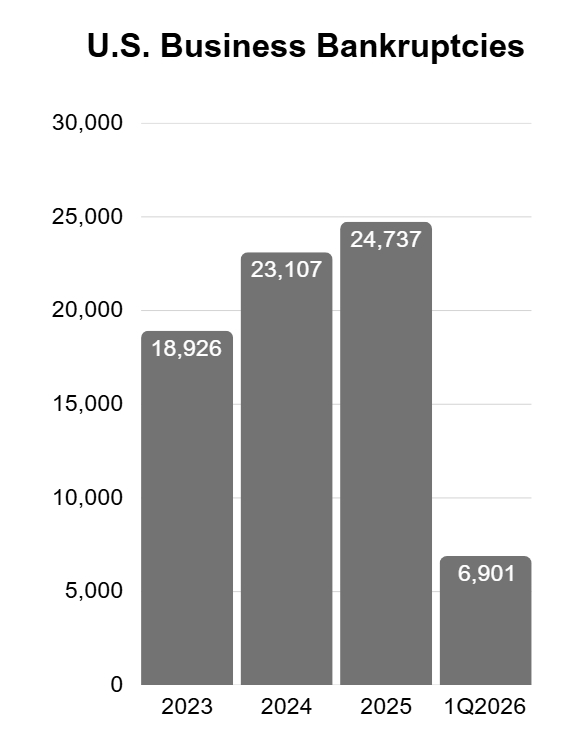
Source: U.S. Bankruptcy Courts—Business and Nonbusiness Cases Filed, by Chapter of the Bankruptcy Code
Current & Evolving Credit Risks
Global Supply Chains Under Renewed Pressure
The New York Fed’s Global Supply Chain Pressure Index (GSCPI) has surged at its fastest rate since April of 2022. The GSCPI integrates a number of commonly used metrics with the aim of providing a comprehensive summary of potential supply chain disruptions. Global transportation costs are measured by employing data from the Baltic Dry Index (BDI) and the Harpex index, as well as airfreight cost indices from the U.S. Bureau of Labor Statistics. The GSCPI also uses several supply chain-related components from Purchasing Managers’ Index (PMI) surveys, focusing on manufacturing firms across seven interconnected economies: China, the euro area, Japan, South Korea, Taiwan, the United Kingdom, and the United States. Active supply chain monitoring should remain a top priority for management in 2026.
Farm Distress
U.S. Chapter 12 filings, a streamlined restructuring designed specifically for family farms and fisheries, spiked 130% in April 2026 to 62 filings from April 2025’s total of 27. The April Chapter 12 total is the highest monthly total since February 2020. According to the American Farm Bureau Federation, Chapter 12 farm bankruptcies climbed 46% in 2025. The farming sector remains under intense pressure as farm finances are being squeezed by relatively low commodity prices. Fertilizer and diesel prices have also surged after the pandemic, and the recent conflict in Iran has added more pressure by driving nitrogen and fuel prices higher.
Slump in EV Sales
Policy uncertainty, infrastructure gaps, and supply chain fragility are weighing on EV momentum and elevating credit risk across the ecosystem. Since the expiration of the U.S. federal $7,500 EV tax credit in September 2025, consumer demand for battery-powered vehicles has weakened significantly. Deliveries declined 27% in the first quarter of 2026, following a 46% drop in the fourth quarter of 2025, according to Cox Automotive. In response, several automakers have scaled back or delayed EV programs, creating knock-on risks for suppliers with high exposure to EV platforms. While higher gas prices are driving interest in fuel efficiency, Cox Automotive data suggests most consumers continue to favor hybrids and efficient internal combustion vehicles over EVs.