


Middle east conflict clouds 2026 outlook
Economic Update
In support of its dual mandate to maximize employment and maintain inflation at 2%, the Federal Reserve opted to hold its target range for the federal funds rate at 3.5%–3.75%. The March decision aligned with market expectations, as uncertainty surrounding the economic outlook remains elevated. The Fed also noted that a key source of uncertainty is the potential impact of the Middle East conflict on energy prices. Chair Jerome Powell highlighted concerns about the risk of undermining the 2% inflation target by “looking through” oil price shocks and tariff-driven inflation pressures. Overall, the central bank appears positioned to cut rates once in 2026, but are taking a “wait and see” approach.
State of Corporate Credit
As reported by Morningstar DBRS, distressed exchange transactions accounted for 94% of downgrades to D or SD for the trailing 12 months ending February 2026, compared with 44% of defaults for the full-year 2024. This trend reflects borrowers’ continued challenges with declining revenues, weak operating margins, and heavy debt burdens. The elevated pace of defaults is expected to persist into 2026. Risk professionals should closely monitor CCC through C rated borrowers, particularly those that have relied on covenant waivers or amendments, or required external capital support. Absent a meaningful improvement in operating performance, default risk remains high in these categories.
Insolvencies
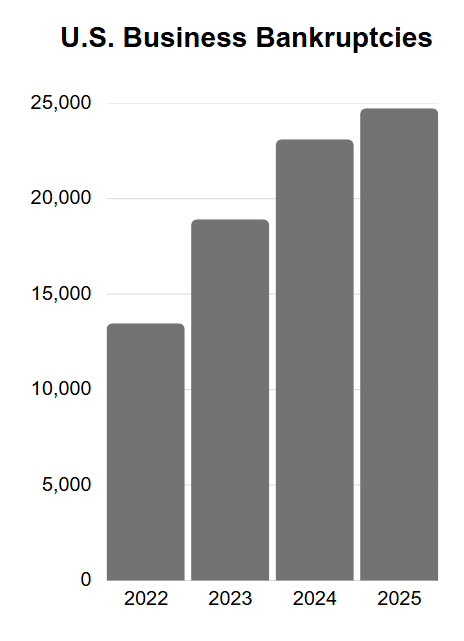
Subchapter V filings within Chapter 11 rose 91% year over year in February 2026, signaling increased financial stress among small businesses. Commercial Chapter 11 bankruptcies also increased 67% year over year, partly driven by clusters of related large cases. Overall, total commercial filings were up 21% year over year as businesses contend with inflationary pressures, softer demand, and rising geopolitical conflict. In Canada, the total number of insolvencies in January 2026 was 1.3% higher than the total number of insolvencies in January 2025. Consumer insolvencies increased by 1.9%, while business insolvencies decreased by 13.4%. The Canadian economy remains under pressure from U.S. tariffs, while an impending USMCA review adds uncertainty for businesses.
Current & Evolving Credit Risks
Strait of Hormuz
The conflict in the Middle East has severely disrupted shipping through the Strait of Hormuz, pushing up prices for diesel, jet fuel, fertilizer, and other petroleum products. Roughly one‑fifth of the world’s oil passes through the strait, making it a critical chokepoint and a central flashpoint in the conflict. LNG exports from Qatar and the UAE, together accounting for nearly 20% of global supply, are also being affected. The longer these disruptions persist, the greater the economic impact, increasing cost pressures on both businesses and consumers. Sharp increases in oil prices act like a tax on the economy, driving up input costs across transportation, manufacturing, agriculture, and consumer goods sectors, slowing growth and adding inflationary pressure.
U.S. Securities and Exchange Commission Potential Change
The U.S. Securities and Exchange Commission is reportedly preparing a proposal that would eliminate the requirement for publicly traded companies to report earnings quarterly, potentially as soon as next month. The proposal would be followed by a standard 30‑day public comment period before a commission vote, though approval is not guaranteed. If adopted, quarterly reporting would become optional. Supporters argue the change could help reverse the decline in U.S. public companies, as many firms cite the cost and administrative burden of public reporting as a reason for staying private. From a credit perspective, less frequent disclosures could hinder risk professionals’ ability to monitor and assess risk effectively.
United States-Mexico-Canada Agreement (USMCA)
The United States–Mexico–Canada Agreement (USMCA), which took effect on July 1, 2020, was designed to create a more balanced and reciprocal trade framework than its predecessor, NAFTA. Renewal discussions will take place this year, with the United States seeking changes to the pact. In December, the top U.S. trade negotiator told Politico that Trump would consider withdrawing from the agreement if his demands are not met. While the three countries could extend USMCA unchanged for another 16 years, a scenario widely seen as unlikely, they may continue negotiations. Under the agreement’s complex review process, they have until 2036 to reach a deal or the pact will expire.