
Market and credit pressures intensify
Economic Update
U.S. economic growth slowed in the fourth quarter of 2025, rising at an annualized 1.4% quarter‑on‑quarter, well below the 3.0% consensus estimate and a sharp step down from Q3’s 4.4%. The shutdown was the primary driver. For the full year, the economy grew 2.2% in 2025, compared with 2.8% in 2024. 2026 sentiment is mixed. Fiscal tailwinds–from the One Big Beautiful Bill Act and ongoing investment in AI–are likely to provide support, but uncertainty around tariffs and trade policy remain a key risk. On the monetary-policy front, recent Fed minutes showed no urgency to resume rate cuts, with some officials open to hikes if inflation stays high. With the next meeting on March 17-18, analysts widely expect a rate hold.
State of Corporate Credit
S&P Global Ratings expects the U.S. speculative‑grade default rate to end 2026 at 3.75%, just above 2025’s 3.69%, driven by elevated market yields and rising CCC/C defaults. Consumer resilience is weakening as job and wage growth slow, confidence drops, and delinquencies rise. This poses a risk since consumer‑dependent sectors represent about one‑third of CCC/C ratings. Furthermore, about 66% of 2025 defaults stemmed from distressed exchanges, which often precede future defaults. At the same time, the average time between subsequent defaults has been falling, shrinking from 4.9 years in 2020 to 2.3 years in 2025.
Insolvencies
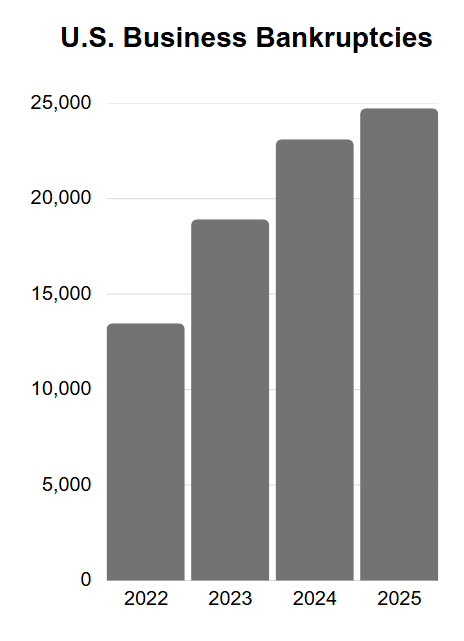
Commercial Chapter 11 filings rose sharply in January 2026, reaching 956, up 76% from 544 in January 2025. Subchapter V small‑business filings also increased 68% from a year earlier according to Epiq AACER data. Businesses continue to face higher operating costs, tighter lending conditions, and geopolitical uncertainty.
In Canada, business insolvencies declined in 2025 to 4,840 filings, down 21.8% from 2024. However, despite this improvement, volumes remain elevated, 31.5% above the pre‑pandemic average (2016–2019), as many firms continue to struggle with higher costs and tighter margins. Ongoing uncertainty around cross-border trade and export demand remains a headwind.
Current & Evolving Credit Risks
Supreme Court Rejects Trump’s Emergency Tariffs
On February 20, 2026, the U.S. Supreme Court struck down Trump’s global tariffs, ruling 6-3 that the administration had unconstitutionally invoked the International Emergency Economic Powers Act of 1977. The IEEPA tariffs impacted include the emergency border tariffs on Canada, Mexico, and China, in addition to reciprocal trade measures placed on most countries to address high trade deficits. Penn‑Wharton Budget Model economists estimated that Trump’s IEEPA‑based tariffs had generated more than $175 billion, an amount that will likely need to be refunded to importers. While the decision invalidates the legal basis for these tariffs, refunds are not automatic. In response, the Trump administration said it will impose a new 15% global tariff under Section 122 of the Trade Act of 1974 and confirmed that existing Section 232 and Section 301 tariffs will remain fully in place.
U.S. Dollar Weakness
The U.S. dollar index, which tracks the dollar against a basket of its currency peers, is down about 12% from its peak in January 2025. S&P reports that tariff uncertainty, geopolitical instability, soaring government debt and challenges to the Federal Reserve’s independence have diluted the dollar’s safe-haven status, boosting the risk of higher borrowing costs and further straining the U.S. economy. We note currency volatility introduces significant risk in cross-border transactions. Continued dollar weakness may support export-driven growth for U.S. firms, but it also heightens credit risk for import-dependent businesses and those with unhedged foreign-currency obligations.
Oil Futures Surge on Rising U.S.-Iran Conflict
As reported by Morningstar, crude continued its upward momentum from the previous session as traders increasingly price in the risk of imminent U.S. military action against Iran. Analysts at ING noted that negotiations appear to be stalling, reducing the likelihood of a diplomatic off-ramp. Rising tensions in Iran have heightened concerns about potential disruptions to global oil supplies, resulting in a surge in energy prices. Sharp increases in oil prices act like a tax on the economy, driving up input costs across transportation, manufacturing, agriculture, and consumer goods sectors, slowing growth and adding inflationary pressure.