


markets shrug off white house noise — For Now
Economic Update
The federal funds target rate stands at 3.50%–3.75% following the Fed’s December rate cut. Fed Chair Jerome Powell noted that the Fed’s dual mandate is under increased strain, as persistent price pressures intersect with signs of labor‑market softening. The annualized inflation rate remains above the Fed’s long-term goal of 2%, most recently holding at 2.7% in December. Looking ahead, markets expect the Fed to hold rates steady at its January meeting, with the next cut anticipated in June.
State of Corporate Credit
The latest Federal Reserve Senior Loan Officer Opinion Survey shows that banks tightened lending standards for commercial and industrial (C&I) loans across all firm sizes. Demand for C&I loans strengthened among large and middle‑market firms but remained essentially unchanged for small firms. Despite this steady demand, banks tightened several terms for small‑firm C&I loans, including reducing maximum credit line sizes, increasing collateral requirements, and applying interest‑rate floors more frequently. Banks cited higher customer needs for inventory and accounts‑receivable financing and M&A activity as the primary drivers of stronger loan demand.
Insolvencies
U.S. commercial bankruptcy filings rose 5% in 2025 compared to 2024. In December alone, commercial Chapter 11 filings were up 6% year over year. Filings by industrial, construction, and trading firms rose in 2025, driven largely by tariffs and higher prices. Smaller companies are especially vulnerable. Unlike large firms that can negotiate tariff-related concessions, absorb costs, or pass them on, smaller businesses lack that leverage and often end up as price takers. Reflecting this strain, Subchapter V small‑business Chapter 11 elections increased 11% in 2025, including a 36% spike in December. Insolvencies in Canada (bankruptcies and proposals) rose 0.4% in the 12 months ending November 30, 2025, with the largest increases occurring in Agriculture, Mining, and Oil & Gas.
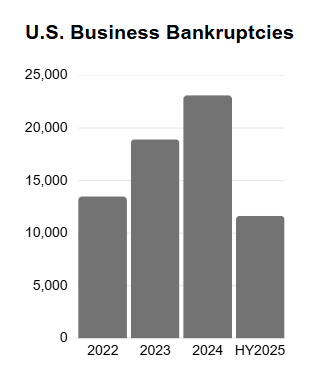
*2025 BK data is delayed due to the government shutdown
Current & Evolving Credit Risks
Repeat Defaulters
Companies that have defaulted in the past can be more susceptible to defaulting again. S&P data reported that repeat defaulters were prevalent in 2025, with 48 defaults recorded by issuers that had defaulted at least once before highlighting some issuers’ reliance on distressed exchanges because they remain unable to achieve long-term balance sheet stability. In 2024, 42 companies were repeat defaulters. This means that nearly 41% of all 2025 defaults involved issuers that had already defaulted at least once before. This is why reviewing a company’s credit character and default history is crucial when making a credit decision.
Markets Unbothered Despite Tensions
Despite rising geopolitical tensions in 2026, global equity markets continue to climb. Investors have largely grown desensitized to President Trump’s unpredictable statements and rapid policy shifts. Analysts note that markets typically react only when developments directly affect economic fundamentals or signal real policy changes. Trump’s moves on Iran, Venezuela, and even Greenland have had little market impact partly because other major economic and military powers have not responded in ways that alter the global outlook. Lastly, with a Supreme Court ruling on Trump’s tariffs imminent, global investors seem to have already adapted.
PE-Backed Bankruptcies Dip, Risks Remain
Fewer U.S. private equity-owned portfolio companies filed for bankruptcy protection in 2025, as sponsors increasingly turned to private credit to address liquidity pressures and favored out-of-court restructurings to keep financially distressed businesses out of the public eye, according to data from S&P Global Market Intelligence. Private credit managers’ continued willingness to lend to troubled, private equity-backed companies helped suppress formal bankruptcy filings. As of December 14, 66 U.S. portfolio companies had filed for bankruptcy in 2025, down from 81 filings recorded in all of 2024. However, with U.S. private equity deal value jumping 43% in 2025, the durability of this trend bears close watching.