

challenges Ahead, but opportunities too
Economic Update
The Federal Reserve lowered interest rates by 25 basis points at its final meeting of 2025, bringing the federal funds rate to a range of 3.50%–3.75%. This marks the fourth consecutive decision that lacked unanimous support among the 12-member Federal Open Market Committee, underscoring the central bank’s delicate balancing act between rising unemployment and inflation above the Fed’s 2% target rate. The November jobs report adds pressure for further rate cuts. Employers added just 64,000 nonfarm payroll jobs in November, following a sharp decline of 105,000 in October. Meanwhile, the unemployment rate climbed to 4.6%, up from 4.4% in September, reaching its highest level since September 2021.
State of Corporate Credit
Analysts expect private credit borrowers to face declining credit quality and continued downgrades in 2026. U.S. borrowers will struggle with margin pressure from inflation and tariffs, alongside rising leverage. Morningstar DBRS found that among borrowers active for more than one year, approximately 12% have negative cash flow and 13% have interest coverage below 1x, up from 7% and 8% one year ago, respectively. The weakest borrowers continue to face weak top-line performance, shrinking margins, and eroding liquidity.
Insolvencies
U.S. Commercial Chapter 11 bankruptcy filings rose 20% year-over-year in November, driven largely by larger corporate parent companies. Small business filings also climbed 23% compared to November 2024, as firms continue to grapple with elevated input costs and persistent geopolitical uncertainty. While Canadian business bankruptcies remain relatively subdued, 2026 is shaping up to be another turbulent year. Companies are expecting to face mounting cost pressures, a weak Canadian dollar, and a slowing economy, factors that will weigh heavily on businesses, particularly those exposed to tariffs.
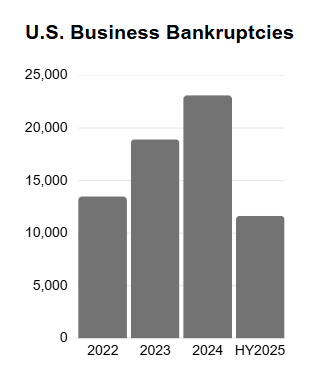
*YTD September 30, 2025 BK data is delayed due to the government shutdown
Current & Evolving Credit Risks
Opportunities for 2026
Credit conditions for borrowers in North America will likely be favorable, driven by corporate spreads that are near historic lows and lower interest rates. Financing conditions are expected to remain supportive. Pent-up demand, stock market highs, and lower interest rates have fueled a surge in M&A activity in the back half of 2025. In North America specifically, despite ongoing policy uncertainty and market volatility, robust GDP growth coupled with the Federal Reserve’s signal for additional rate cuts are driving increased strategic activity into 2026.
PMI Ends 2025 on a Soft Note
U.S. Manufacturing PMI slipped to 51.8 from 52.2, marking a fifth straight month of expansion but at the slowest pace in that stretch. New orders declined and backlogs fell, leading factories to cut input purchases for the first time since April. Inventories of unsold goods continued to build, though more moderately than the record buildup in October and November. Meanwhile, inflationary pressures intensified sharply in December, with higher prices widely attributed to tariffs. Employment growth also worsened in December, with businesses reporting concerns over costs, lackluster demand, and uncertainty over the economic outlook, though some companies continued to report labor shortages.
Renewable Projects Under Pressure
On July 4, 2025, President Trump signed the One Big Beautiful Bill Act (OBBB), rolling back key clean energy tax incentives. Renewable projects now face shorter credit timelines and supply-chain hurdles. So far in 2025, $28.7 billion in battery, storage, solar, EV, and wind projects have been canceled, closed, or scaled back. The abandonment of 51 projects this year alone reflects heightened uncertainty among manufacturers and investors about the landscape, impacting jobs and supply chains in these sectors.